Oil & Gas Digitalisation
Digital oilfield implementation across production, operations and supply chain
ERN helps operators and their connected oilfield-service, maintenance, warehouse, procurement and logistics ecosystem turn field events into prioritised, compliant supply-chain decisions instead of emergencies.
Effective · Reliable · Affordable — delivered with our strategic technology partners.
Why now
Operating intensity is rising while supply-chain complexity stays structural
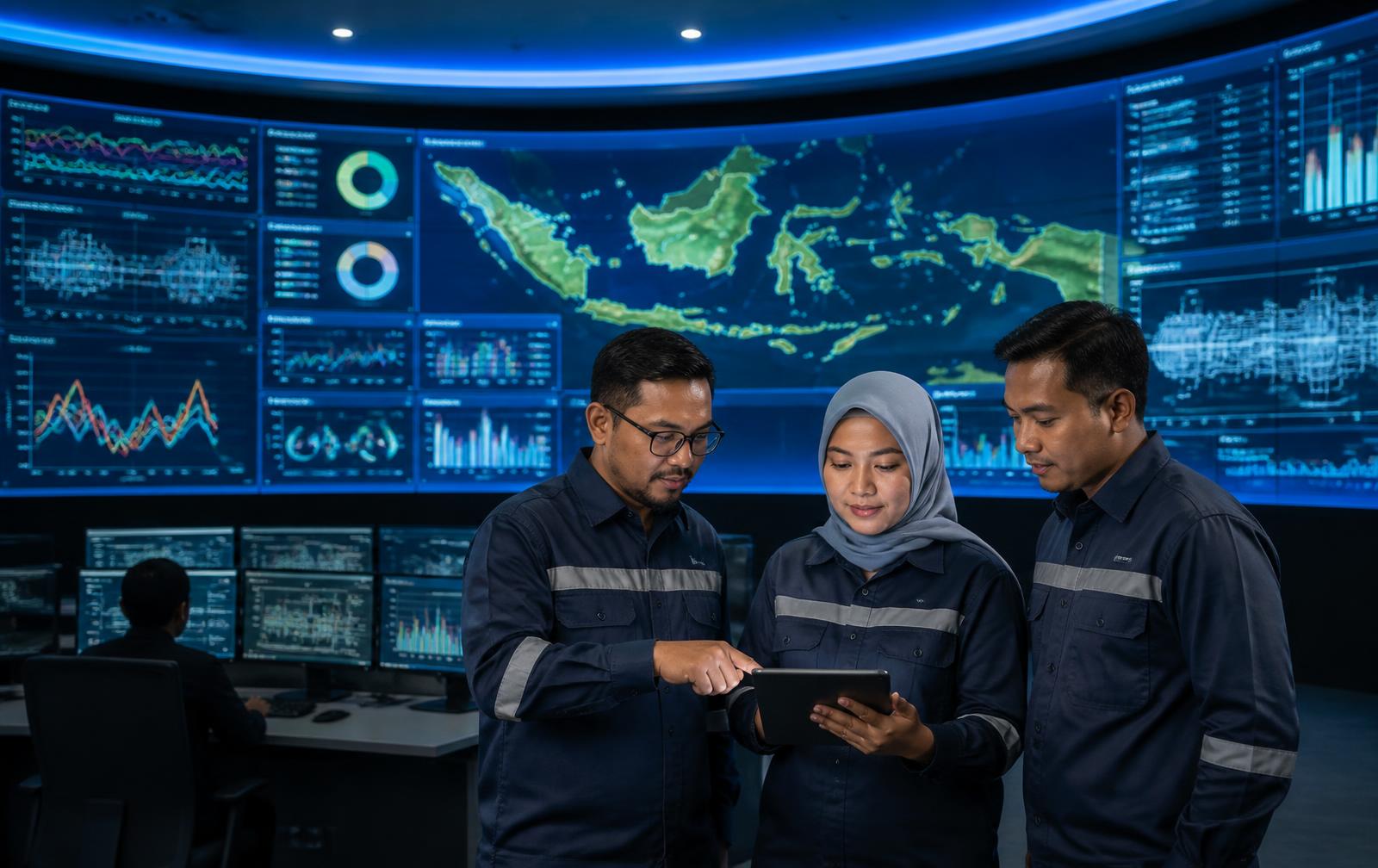
Indonesian upstream operations are past the pilot stage: integrated operations centres, digital twins and predictive maintenance are already protecting national production. The remaining value sits in the hand-offs between field, maintenance and SCM.
Mature-field reliability
High intervention frequency
Improving digital readiness
Scope of digitalisation
One programme covering the full production and operations chain
We do not sell a single dashboard. We integrate around events and APIs so existing SCADA, ERP, EAM and e-procurement systems keep working.
Production & reservoir surveillance
Predictive maintenance & integrity
Edge & OT/IT integration
Connected worker & digital HSE
Smart inventory & spares
Logistics control tower
Event-driven procurement
Capability & adoption
SCM focus
Supply chain is where digital oilfield value is won or lost
Thousands of wells, remote and offshore logistics, high intervention frequency and mature-field reliability create volatile demand that static min–max planning cannot absorb.
- Failure detected late in the field
- Parts list and priority not synchronised with maintenance
- Warehouse availability not trusted, so buying happens anyway
- Manual routing and sourcing delays inside procurement
- No live supplier commitment or ETA signal
- Expedited freight and poorly utilised loads
Value pools
Where digitalisation converts into money
- Rig & facility NPT — 15–35% lower downtime cost
- From “failure → urgent requisition” to “risk detected → material staged before the intervention”.
- Inventory — 20–30% working-capital release
- Dynamic buffers driven by live consumption, well plans, lead time and criticality instead of blanket safety stock.
- Logistics — 10–20% lower transport cost
- Consolidated movements and optimised routes replace hot-shot freight after failures.
- Asset lifecycle — 10–15% CAPEX re-buy savings
- Condition-based repair-vs-replace decisions extend component life without eroding safety margin.
- Procurement — 50–70% faster PO cycle
- Low-complexity demand flows automatically; specialists focus on strategy, negotiation and exceptions.
Indicative improvement ranges reflect industry working assumptions and are validated against your own downtime, cost and cycle-time baseline during the diagnostic.
Operating model
Sense → decide → execute → learn
AI recommends and orchestrates; your people remain accountable for policy, commercial judgement and exceptions.
- 01SenseAsset health, well plan, rig schedule, stock, fleet, supplier ETA
- 02DecideFailure probability, demand forecast, criticality, sourcing path
- 03ExecuteReserve stock, raise PR/PO, dispatch, confirm delivery
- 04LearnActual consumption, failure mode, lead time, supplier performance
Architecture
Five integration layers from wellhead to supplier
- 1. Edge & OT
- Sensors, SCADA, equipment telemetry, GPS / AIS
- 2. Data platform
- Governed data lake, historian integration, master and reference data
- 3. Intelligence
- Prediction, optimisation, priority scoring, GenAI copilots
- 4. Execution
- ERP / EAM / e-procurement / WMS / TMS / supplier portal
- 5. Governance
- Identity, cyber security, approvals, audit trail, human-in-the-loop
Indonesian guardrails
Automate the workflow, never the accountability
Every workflow we implement stays auditable, vendor-qualified, local-content aware and cyber-secure — aligned to SKK Migas procurement governance.
Operator names, adoption levels and investment figures referenced in market discussions are drawn from publicly available industry information and are used for context only. They do not imply an ERN client relationship or endorsement. Improvement ranges are illustrative working assumptions, not ERN client results.
- PTK-007 aligned procurement workflow and approval thresholds
- CIVD vendor qualification and supplier data integrity
- TKDN / local content visibility inside sourcing decisions
- OT and cyber security segmentation between field and enterprise
- Human escalation for high-value, single-source, safety-critical or ambiguous scope
- Full audit trail: who decided, on what data, under which policy
Delivery roadmap
Prove value on one asset first, then industrialise
- 01Diagnose0–6 weeks · baseline, pilot and KPI selection
- 02Pilot2–4 months · human-in-the-loop workflow, weekly benefit tracking
- 03Scale4–9 months · supplier connectivity, change management
- 04Industrialise9–15 months · process redesign, contract and KPI alignment
- 05Autonomy15–18 months · portfolio value tracking, autonomous decision zones
Start with one asset, one measurable KPI
A 4–6 week diagnostic on a single field or asset identifies the top three closed-loop pilots, the data you already have, and the value at stake.
